If you want a neighborhood that feels a little more tucked-in than central Portland but still keeps you connected, Multnomah Village deserves a close look. For many buyers, the challenge is finding a place with local character, practical commute options, and homes that offer more than a cookie-cutter layout. This guide will help you understand what Multnomah Village is, what kind of housing you’ll find, and how to decide if it matches your goals. Let’s dive in.
What Multnomah Village Really Is
Multnomah Village is not a separate city. It is the historic business district within Portland’s Multnomah neighborhood in Southwest Portland.
That distinction matters when you start searching homes online or comparing areas. What many buyers think of as “Multnomah Village” usually includes the compact commercial core and the nearby residential streets that give the area its neighborhood feel.
City sources describe it as a heart-of-Portland village, and that description fits. The area grew around an Oregon Electric Railway station in the early 1900s, which helps explain why the center still feels compact, established, and pedestrian-oriented today.
Why Buyers Are Drawn Here
A lot of buyers are looking for balance, and Multnomah Village often checks that box. You get a small main street feel, access to parks, and west-side convenience without being in a fully dense urban setting.
For the right buyer, that mix can be very appealing. You may find it especially interesting if you want neighborhood character, older homes, and a setting that feels more relaxed than some closer-in Portland areas.
It may be less ideal if your top priority is a large suburban lot or highly consistent walkability far beyond the core. The area is strongest when your expectations match what it actually offers.
Housing in Multnomah Village
Expect Character Homes and Infill
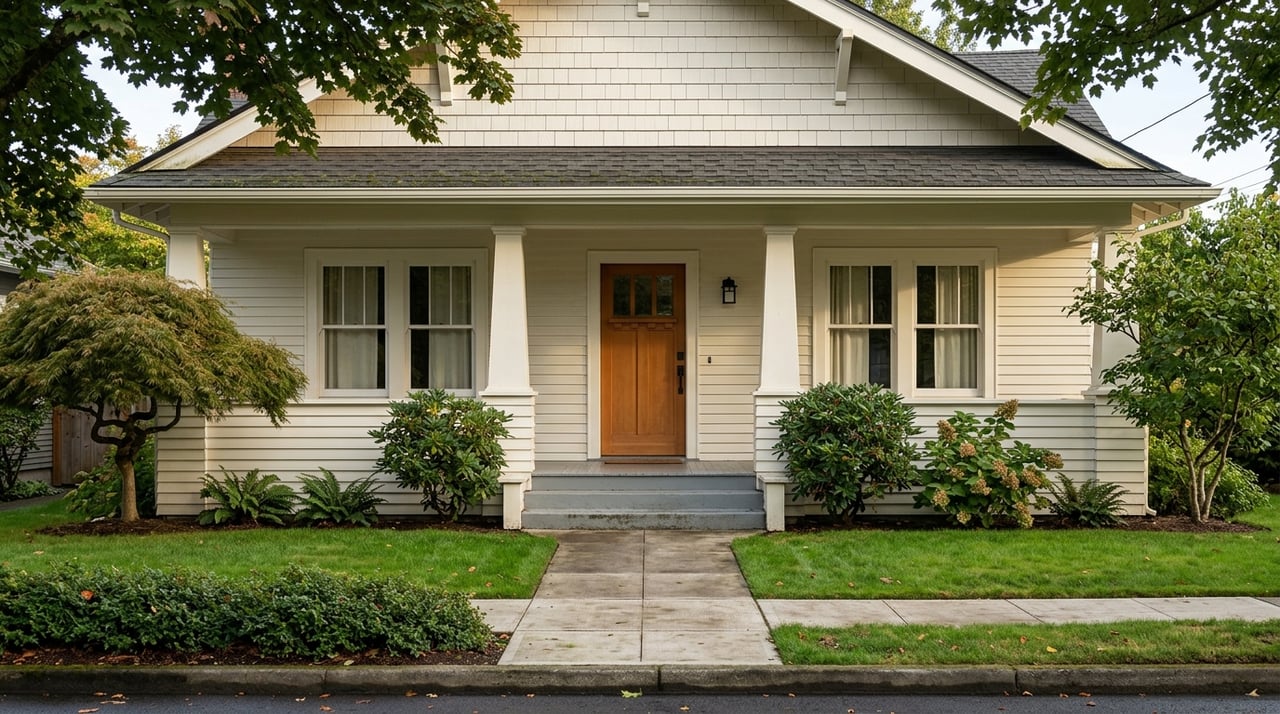
One of the biggest strengths of Multnomah Village is that the housing stock is not all one thing. Nearby homes include early-20th-century Craftsman bungalows and other older home styles, along with newer builds, townhomes, condos, and updated houses.
That means you are not shopping in a uniform subdivision or a brand-new master-planned pocket. Instead, you are more likely to see a mix of character homes, remodeled properties, and selective infill.
Lot Sizes Are Usually Standard
If you are coming from a more suburban market, lot size is important to understand early. Much of the nearby residential area is mapped in R5 and R7 zoning, which generally means one dwelling per 5,000 or 7,000 square feet.
In plain terms, most lots here are usually standard inner Southwest Portland lots, not oversized suburban parcels. That does not mean outdoor space is absent, but it does mean you should calibrate your expectations before you fall in love with the idea of a huge yard.
Renovation Potential Can Be Real
For buyers who are open to improving a home over time, Multnomah Village can offer opportunity. Portland’s zoning rules allow infill options in several residential zones, including ADUs, duplexes, triplexes, fourplexes, and cottage clusters.
The city also notes that ADUs do not require extra on-site parking. Still, the exact potential of any property depends on details like lot width, setbacks, overlays, and building scale limits.
That is why it helps to treat renovation or expansion potential as a bonus to verify, not an assumption to make. Some parcels may offer more flexibility than others, especially near areas with underutilized or vacant land close to the core.
Getting Around Multnomah Village
Driving and Transit Are Key
For many buyers, location only works if daily life feels manageable. Multnomah Village is often described as roughly a 5- to 15-minute drive from downtown Portland, depending on traffic and your starting point.
TriMet routes 44 and 45 serve the area, which adds flexibility if you want options beyond driving. Line 44 connects Multnomah Village to places including PCC Sylvania, Hillsdale, Portland City Center, Union Station, the Rose Quarter, PCC Cascade, and St. Johns.
Line 45 also runs through Multnomah Village, though on weekends it only operates between Tigard Transit Center and Multnomah Village. If transit matters to you, it is smart to compare your likely route and schedule before making a final decision.
Walkability Is Strongest in the Core
Multnomah Village can feel very walkable when you are near the business district. Portland planners describe the core as a walkable island, which is a helpful way to think about it.
As you move farther out, streets can become more auto-oriented. Planners also note that I-5 creates a meaningful barrier for pedestrian movement in some directions, so walkability is not evenly distributed across the broader area.
Biking Has Improved
If biking is part of your routine, there is good news along Capitol Highway. PBOT completed improvements that added sidewalks, a protected bike lane, and a multi-use path between SW Multnomah Boulevard and SW Taylors Ferry Road.
That kind of infrastructure can make a real difference in everyday comfort and safety. Travel Portland also notes that cyclists can get downtown in under an hour, though the route includes about 700 feet of climbing.
Parks and Outdoor Access
One of the easiest things to appreciate about this area is its access to green space. Gabriel Park is a major local amenity at 89.67 acres, with a community center, skate park, dog-off-leash areas, paved paths, a garden and orchard, and natural areas.
Nearby Woods Memorial Natural Area adds another 45.98 acres. Together, those spaces help give the area an outdoorsy, neighborhood-scale feel that many buyers are trying to find.
If you want quick park access without giving up city convenience, this part of Southwest Portland has a lot going for it. That benefit can matter just as much as square footage when you are choosing where to live.
Who Multnomah Village Fits Best
No neighborhood is perfect for everyone, and Multnomah Village is no exception. It tends to fit buyers who want three things at once: a small-town-feeling main street, access to parks, and west-side convenience.
It can be a strong match if you like older homes with personality and are open to standard lot sizes. It also makes sense if you value the possibility of renovation or future flexibility and are willing to verify the details property by property.
You may want to look elsewhere if your top priorities are large lots, uniform sidewalks throughout the area, or easy walkability across all of Southwest Portland. The goal is not to force a fit, but to find the neighborhood that supports how you actually want to live.
What to Verify Before You Make an Offer
Before you write an offer in Multnomah Village, take a close look at the property’s zoning and site details. If you are thinking about remodeling, adding an ADU, or exploring future infill options, you will want to confirm the parcel’s zoning, lot width, and any overlays on PortlandMaps.
This step can save you from expensive assumptions later. A home may look like it has expansion potential, but city rules and site conditions will determine what is actually possible.
It is also wise to think through your daily routine in real terms. Test-drive the commute, walk the immediate blocks, and consider how much proximity to the village core matters to you.
A Smart Way to Shop in Multnomah Village
The best way to buy in Multnomah Village is to shop with clear priorities. Decide early whether your biggest goal is charm, proximity to the business district, park access, transit convenience, or renovation potential.
When you know your priorities, it becomes much easier to sort through the mix of bungalows, updated homes, condos, townhomes, and newer infill. You can focus on what supports your long-term plans instead of getting distracted by features that may not matter as much after move-in day.
A neighborhood like this often rewards patient, informed buyers. If you take the time to understand the housing mix, lot norms, and street-by-street feel, you will be in a much better position to recognize the right opportunity when it appears.
If you are considering a move in Southwest Portland and want practical guidance on how Multnomah Village fits your budget, lifestyle, and long-term plans, Susan Lee can help you navigate the options with a steady, informed approach.
FAQs
Is Multnomah Village a separate city in Oregon?
- No. Multnomah Village is the historic business district within Portland’s Multnomah neighborhood in Southwest Portland.
Are lot sizes in Multnomah Village large?
- Usually not by suburban standards. Much of the nearby residential area is in R5 or R7 zoning, so buyers should generally expect standard inner Southwest Portland lot sizes.
Can you add an ADU in Multnomah Village?
- Often, yes, but it depends on the property. Portland allows several infill types in certain residential zones, and ADUs do not require extra on-site parking, but lot width, setbacks, overlays, and other site details still matter.
How do people commute from Multnomah Village?
- Most people rely on a mix of driving, TriMet bus service, and biking. Routes 44 and 45 serve the area, and Capitol Highway has seen recent walking and biking improvements.
What should buyers verify before buying in Multnomah Village?
- Buyers should confirm the parcel’s zoning, lot width, and any overlays on PortlandMaps before assuming a home has remodel, ADU, or infill potential.